
An Insight on the Cognitive Revolution – Generative AI Meets Retail

The retail sector is at the cusp of an extraordinary transformation, spurred by the integration of generative AI technology. This evolution is set to redefine customer experiences and streamline supply chain mechanisms. "Cognitive Revolution: Generative AI Meets Retail," delves into the vast realm of opportunities that generative AI brings to retail, spanning from enhancing customer interaction, efficient inventory management to personalized marketing techniques. While hurdles like data privacy and content quality exist, they are failing to hinder the breakneck pace of this technological advancement in the retail world.

Scope
Innovation Insights: innovation examples by generative AI use cases in the retail sector to present key trends.
Key Highlights
Innovations: presents real-world innovation examples related to the generative AI use cases in the retail sector. It casts light on how retail sector players are utilizing generative AI technology across key sector-specific application areas.

Reasons to Buy
No surprise that technology has been a driving force in business transformation for years, but the term ‘emerging technologies’ has all of a sudden become the key catalyst to drive the next wave of innovation across sectors.
The sense of urgency weighs differently across different sectors, where the direct customer-facing sectors are at the forefront compared to other capital-intensive sectors. Companies in one sector can take cues from successful innovations in other sectors to either draw analogies with existing products, services, and processes or transfer strategic approaches for a revolutionary transformation.
Against this backdrop, enterprises need to understand which emerging technologies are impacting their sector and how various companies are implementing them to meet various challenges.
The innovation landscape report on retail innovations in generative AI, published by GlobalData as part of an ongoing series, covers some real-world examples to advance the development and implementation of the technology by some of the key enterprises in the retail sector.

Furthermore, The cognitive revolution is a period of rapid advancement in artificial intelligence (AI) that began in the 1950s. Generative AI is a subset of AI that focuses on creating new outputs, such as text, images, and music.
Mapping Use Cases of Generative AI Against Retail Challenges:
The retail industry is constantly evolving, and retailers are always looking for new ways to improve the customer experience and stay ahead of the competition. Generative AI (GAI) is a powerful new technology that has the potential to revolutionize the retail industry.
GAI is a type of AI that can create new outputs, such as text, images, and music. This makes it ideal for a variety of retail use cases, such as:
Product development: GAI can be used to generate new product ideas, design prototypes, and create marketing materials. This can help retailers to stay ahead of the competition and launch new products that meet the needs of their customers.
Inventory management: GAI can be used to forecast demand, optimize inventory levels, and prevent overstocking and understocking. This can help retailers to save money and improve customer satisfaction.
Pricing: GAI can be used to set prices that are both profitable and competitive. This can help retailers to maximize their profits and attract customers.
Marketing: GAI can be used to create personalized marketing campaigns that target specific customer segments. This can help retailers to reach a wider audience and increase sales.
Customer service: GAI can be used to provide 24/7 customer support that is both efficient and effective. This can help retailers to improve customer satisfaction and reduce churn.
GAI is still a relatively new technology, but it is rapidly evolving. As GAI continues to develop, it is likely to have an even greater impact on the retail industry.
Here is a more detailed mapping of GAI use cases against retail challenges:
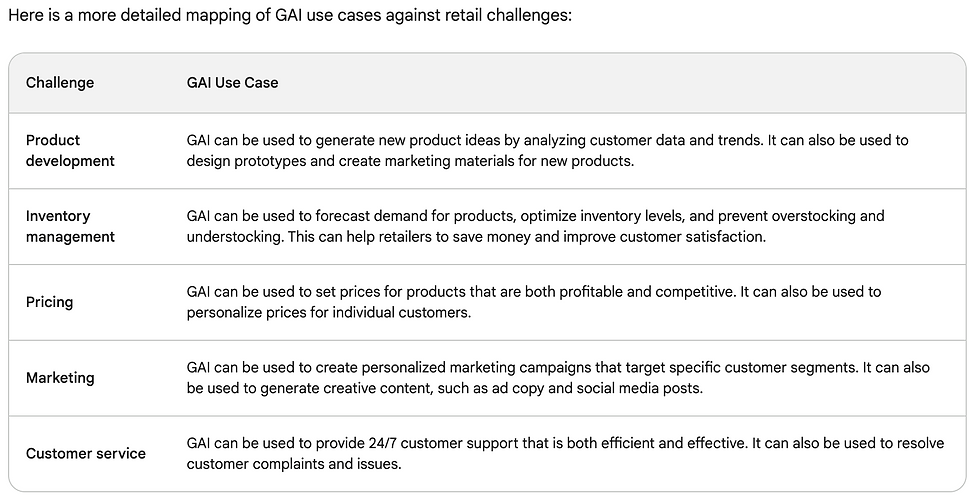
Generative AI (GAI) has the potential to revolutionize the retail industry by addressing some of the biggest challenges facing retailers today. By automating tasks, providing personalized recommendations, and making better decisions, GAI can help retailers to save time and money, improve customer satisfaction, and increase sales.
Here are some examples of how retailers are already using GAI to address retail challenges:
Amazon uses GAI to generate product recommendations for its customers. This helps Amazon to keep customers engaged and coming back for more.
Walmart uses GAI to forecast demand for seasonal products. This helps Walmart to avoid overstocking and understocking, which saves the company money.
Target uses GAI to set prices for its products. This helps Target to maximize its profits and stay competitive.
Sephora uses GAI to create personalized product recommendations for its customers. This helps Sephora to increase sales and customer loyalty.
ChatGPT is a generative AI chatbot that can answer customer questions about products and services. This helps ChatGPT to provide 24/7 customer support that is both efficient and effective.
These are just a few examples of how retailers are using GAI to address retail challenges. As GAI continues to develop, it is likely to have an even greater impact on the retail industry in the years to come.
Finally, Why is Thought leadership so important to overcome the challenges of generative AI in retail ?

It can help retailers to understand the potential of generative AI and how it can be used to address their specific challenges. Generative AI is a complex technology, and it can be difficult for retailers to understand all of its potential applications. Thought leadership can help retailers to learn more about generative AI and how it can be used to improve their business.
It can help retailers to mitigate the risks associated with generative AI. Generative AI is still a relatively new technology, and there are some risks associated with its use. For example, generative AI can be used to create fake content, which could damage a retailer's reputation. Thought leadership can help retailers to understand the risks of generative AI and how to mitigate them.
It can help retailers to build relationships with other retailers and thought leaders in the industry. Thought leadership can help retailers to connect with other retailers who are also interested in using generative AI. This can lead to collaboration and knowledge sharing, which can help retailers to overcome the challenges of generative AI.
It can help retailers to stay ahead of the competition. The retail industry is constantly evolving, and retailers need to be constantly innovating in order to stay ahead of the competition. Thought leadership can help retailers to learn about the latest trends in generative AI and how they can be used to improve their business.
Overall, thought leadership is an important tool that retailers can use to overcome the challenges of generative AI. By understanding the potential of generative AI, mitigating the risks associated with it, building relationships with other retailers and thought leaders, and staying ahead of the competition, retailers can use generative AI to improve their business.
Here are some specific examples of how thought leadership can be used to overcome the challenges of generative AI in retail:

Retailers can publish white papers or blog posts about the potential of generative AI in retail. This can help to educate other retailers about the benefits of generative AI and how it can be used to improve their business.
Retailers can attend conferences and events where generative AI is being discussed. This can help them to learn from other retailers who are already using generative AI and to network with thought leaders in the industry.
Retailers can collaborate with other retailers on generative AI projects. This can help them to share resources and expertise, and to learn from each other's experiences.
Retailers can sponsor research into generative AI. This can help them to stay ahead of the curve and to identify new applications for generative AI in retail.
By engaging in thought leadership, retailers can overcome the challenges of generative AI and use this powerful technology to improve their business.


Comments